Tag: Law
-

Call for Papers: Twenty-First Century Media? Affective Bodies, Crowds and Collectives
In the last two decades, digital media infrastructures have spread worldwide, including the global South. Despite inequalities of access, low-cost mobile devices and cheaper broadband have connected large subaltern populations to media infrastructures. The effects are increasingly planetary, initiating a series of debates in media scholarship and cultural theory. Mediatisation has emerged as a material…
-

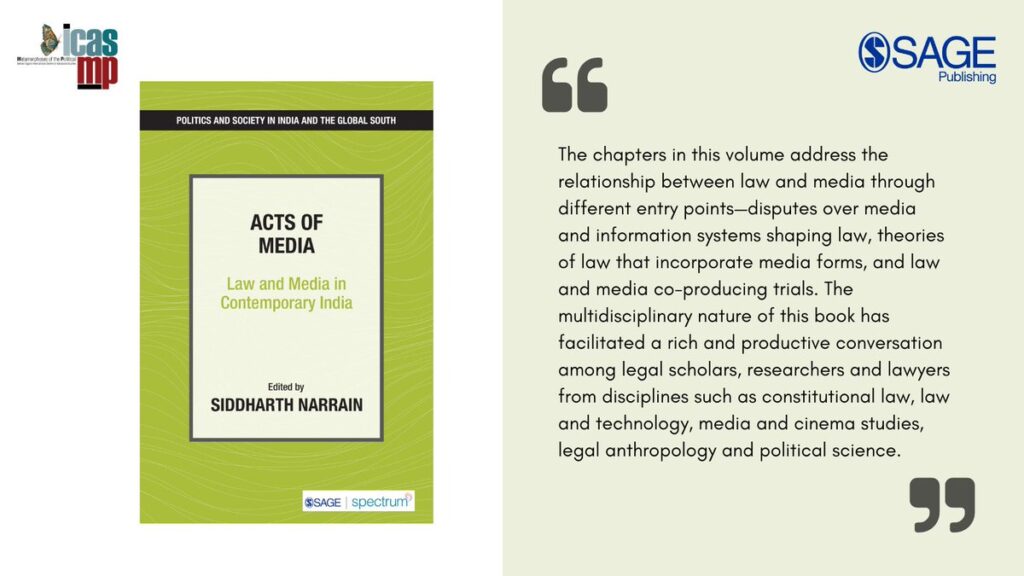
Acts Of Media: Law And Media In Contemporary India
Acts of Media seeks to consolidate a field of multidisciplinary work around media technologies that intersects with legal scholarship. This volume brings together contributions from leading academics, lawyers, researchers and policy experts about contemporary India and Sri Lanka. This volume brings together contributions from leading academics, lawyers, researchers and policy experts about contemporary India and Sri Lanka…
-

Law at Large: The News Event in Public Mediations of Community – Lecture by Francis Cody
Francis Cody will deliver a lecture on ‘Law at Large: The News Event in Public Mediations of Community’. It will be chaired by Ravi Sundaram. Friday, 28 July 2023, 4.30 pm, Seminar Room and Zoom https://bit.ly/43dFv6t CLICK TO JOIN THE LECTURE ZOOM ID: 88461683987 PASSCODE: csdsdelhi Excerpted from a chapter of The News Event: Popular Sovereignty…
-
Media and the Constitution of the Political
This project, supported by ICAS:MP, speaks to the following thematic engagements: Social Media, Data and Information Infrastructures This project looks at data and information infrastructures that have emerged from the rise of social media. Governments have been modernising data collection while addressing paper-based systems. Private companies work with a host of smaller intermediaries and advanced analytics…
-
Law and Social Media
The advent of social media and its increasing use in India has led to numerous questions concerning its legal regulation. Our research commenced with questions around incidents of communal and ethnic violence where social media has been ascribed an important role – the Bangalore and Pune North East exodus of 2012, the Azad Maidan disturbance…
-

The Act Of Media Workshop – Report & Recordings
The Act of Media Workshop, 08-10 January 2016, brought together academics, researchers, and legal practitioners, to discuss themes that were broadly related to law, media and technology. One of the main aims of the workshop was to breakdown disciplinary boundaries, and rethink categories such as ‘media law’. The workshop was divided into six substantive sessions,…
-
The Act Of Media Workshop – Report & Recordings
The Act of Media Workshop, 08-10 January 2016, brought together academics, researchers, and legal practitioners, to discuss themes that were broadly related to law, media and technology. One of the main aims of the workshop was to breakdown disciplinary boundaries, and rethink categories such as ‘media law’. The workshop was divided into six substantive sessions,…
-

The Act of Media: Workshop on Law, Media and Technology
The Sarai Programme, Centre for the Study of Developing Societies is organising The Act of Media workshop on 8th to 10th January 2016. The workshop examines how media-enabled subjectivities produce new sites of departure in the law. The shift from theatre to cinema; cinema to video; and video to satellite television have been productive sites…
-
The Act of Media: Workshop on Law, Media and Technology
The Sarai Programme, Centre for the Study of Developing Societies is organising The Act of Media workshop on 8th to 10th January 2016. The workshop examines how media-enabled subjectivities produce new sites of departure in the law. The shift from theatre to cinema; cinema to video; and video to satellite television have been productive sites…
-

Social Media Research Workshop, November 06, 2015
Since March this year, short-term research fellows have been involved with The Sarai Programme, on themes that relate to digital and social media. On Friday, 6th November 2015, we are organising a workshop for the fellows to present and discuss their research with a select group of discussants. The workshop will be held at the Centre for the Study of Developing Societies, 29 Rajpur Road, Civil Lines.