Tag: Cinema
-

The Many Lives of Indian Cinema Conference – Recordings – Day 02
Day 01, January 09, 2014 | Day 02, January 10, 2014 | Day 03, January 11, 2014 Histories: Cities I Early Film-going as Heterotopic Mobility: Urban Journeys, Public Space and Cinema Theatres in Chennai Stephen Putnam Hughes, School of Oriental and African Studies, London Download: OGG and MP3. Cinema in the Colonial City: Early…
-
The Many Lives of Indian Cinema Conference – Recordings – Day 01
Day 01, January 09, 2014 | Day 02, January 10, 2014 | Day 03, January 11, 2014 Histories: Connections and Comparisons Intimacy and Industry: Close Encounters Between Hollywood and Bombay Nitin Govil, University of Southern California, Los Angeles Download: OGG and MP3. Asian Cinergy: Chinese Film in the Age of the International Blockbuster and…
-
The Many Lives of Indian Cinema: Conference Report
This conference was part of the golden jubilee celebrations of the Center for the Study of Developing Societies and was organized by The Sarai Programme to commemorate 100 years of Indian cinema. The conference sought to draw on the diverse heritage of Indian cinema to highlight the importance of cinema studies in the wider architecture…
-

The Many Lives of Indian Cinema: Conference Report
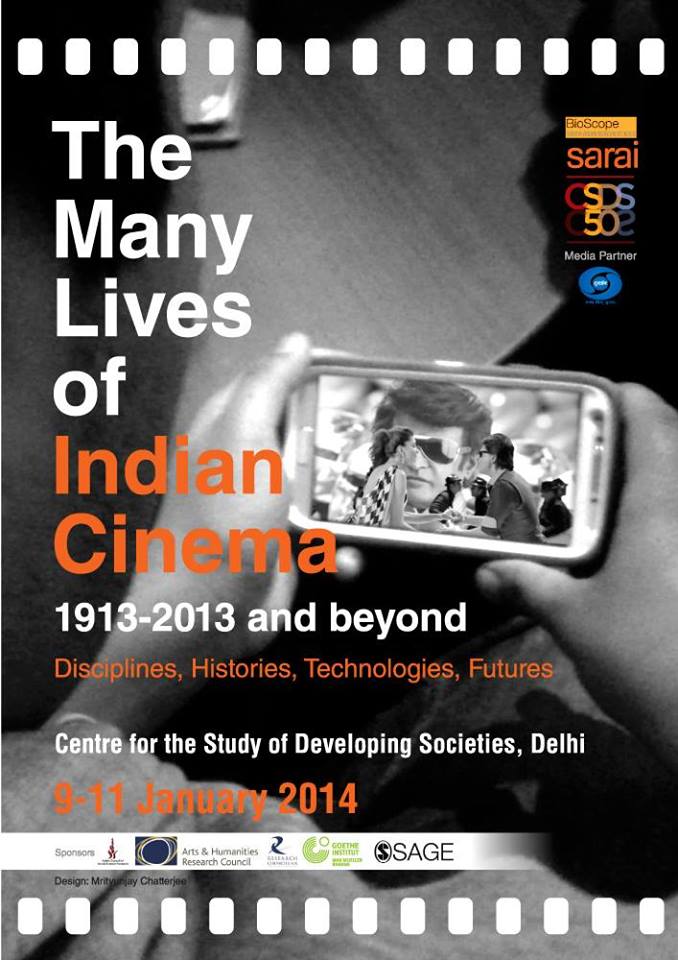
This conference was part of the golden jubilee celebrations of the Center for the Study of Developing Societies and was organized by The Sarai Programme to commemorate 100 years of Indian cinema. The conference sought to draw on the diverse heritage of Indian cinema to highlight the importance of cinema studies in the wider architecture of disciplinary engagements. This was with a view to bringing cinema into the academy as subject matter that required not only specialist analysis, but also as something which offered fresh perspectives, methods and materials to the human sciences.
-
The Many Lives of Indian Cinema: 1913-2013 and beyond
This international conference was hosted by the Centre for the Study of Developing Societies (CSDS) to celebrate and reflect on a century of Indian cinema. The conference was coordinated by the Sarai programme of CSDS and the CSDS/Sarai-supported South Asian screen studies journal, BioScope. It was part of the Golden Jubilee Celebrations of the Centre…
-
The Many Lives of Indian Cinema: 1913-2013 and beyond
This international conference was hosted by the Centre for the Study of Developing Societies (CSDS) to celebrate and reflect on a century of Indian cinema. The conference was coordinated by the Sarai programme of CSDS and the CSDS/Sarai-supported South Asian screen studies journal, BioScope. It was part of the Golden Jubilee Celebrations of the Centre…
-

Thomas Elsaesser – Cinema after Film | Friday, January 10, 7 pm
We invite you to a CSDS Golden Jubilee Lecture on Cinema After Film: On the future of obsolescence of the moving image by Thomas Elsaesser Chaired by Ravi Vasudevan. The lecture concerns itself with the dynamics and consequences of rapid media transfer, especially as they apply to the cinema as cultural memory and artistic practice…
-
Thomas Elsaesser – Cinema after Film | Friday, January 10, 7 pm
We invite you to a CSDS Golden Jubilee Lecture on Cinema After Film: On the future of obsolescence of the moving image by Thomas Elsaesser Chaired by Ravi Vasudevan. The lecture concerns itself with the dynamics and consequences of rapid media transfer, especially as they apply to the cinema as cultural memory and artistic practice…
-
FD Zone Delhi and BioScope Screenings – ‘Pedagogic States’ and ‘The Act of Killing’
Cross-posted from fdzonedelhi. FD Zone Delhi and BioScope invite you to a screening of documentaries on Tuesday, January 07, 2014, at India Islamic Centre, Lodhi Road, New Delhi. The programme is presented by FD Zone, Delhi Chapter, The Sarai Programme at CSDS, BioScope, and the Centre for Research in Education, Art and Media (CREAM)…
-
FD Zone Delhi and BioScope Screenings – ‘Pedagogic States’ and ‘The Act of Killing’
Cross-posted from fdzonedelhi. FD Zone Delhi and BioScope invite you to a screening of documentaries on Tuesday, January 07, 2014, at India Islamic Centre, Lodhi Road, New Delhi. The programme is presented by FD Zone, Delhi Chapter, The Sarai Programme at CSDS, BioScope, and the Centre for Research in Education, Art and Media (CREAM)…